Evaluating Isometric Business Strategy Illustration for Professional Design Projects
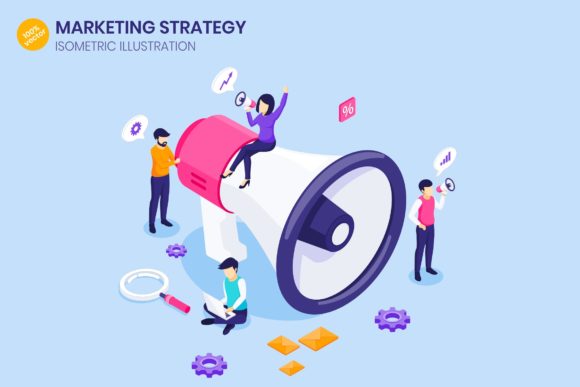
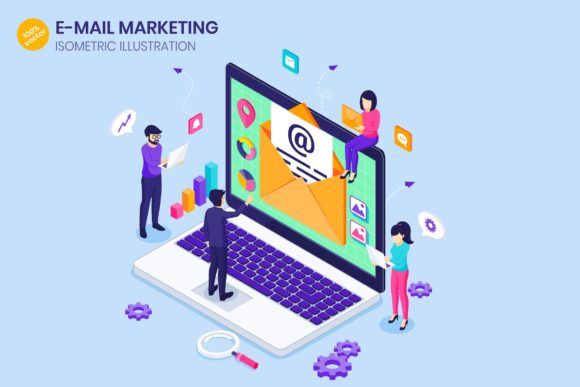
In the evolving landscape of digital design, visual communication plays a pivotal role in how audiences perceive complex information. Among the various styles available to designers and business owners, the Isometric Business Strategy Illustration has emerged as a dominant trend for conveying corporate concepts. This style utilizes a specific geometric perspective to create three-dimensional scenes on a two-dimensional plane, offering a clean, modern, and highly structured way to visualize topics such as business planning, marketing strategies, financial consulting, and project management.
For professionals researching design assets for web graphics, landing pages, or infographics, understanding the utility and limitations of isometric vector illustration is essential. This article evaluates the characteristics of this design approach, helping you determine if it aligns with your specific project goals and technical requirements.
Understanding the Isometric Concept in Business Contexts
Isometric illustration is defined by its lack of vanishing points. Unlike traditional perspective drawing where objects get smaller as they recede into the distance, isometric designs maintain parallel lines and consistent scale throughout the image. When applied to business strategy concepts, this creates a sense of order, stability, and clarity.
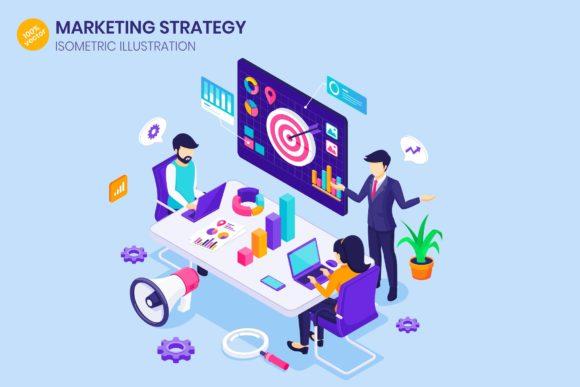
A typical scene might feature business people gathered around a meeting table, analyzing charts, or engaging in collaborative planning. Because the angle allows viewers to see the top and two sides of objects simultaneously, it is exceptionally effective for displaying data, workflows, and organizational structures. Whether depicting a marketing target, a financial growth chart, or a consulting session, the isometric view ensures that every element remains visible and legible, avoiding the occlusion issues common in other artistic styles.
Key Benefits of Vector-Based Isometric Assets
When selecting design resources, the underlying file format is just as critical as the visual style. High-quality isometric illustrations are typically delivered as 100% vector files. This technical specification offers several distinct advantages over raster-based images (like standard photographs or pixel-based paintings).
- Infinite Scalability: Vector graphics use mathematical equations to define shapes rather than fixed pixels. This means an isometric illustration can be resized from a small mobile icon to a massive billboard banner without losing any quality or becoming pixelated. This is crucial for responsive web design where images must adapt to various screen sizes.
- Editability and Customization: A significant benefit of using source files like Adobe Illustrator (.Ai) or EPS10 is the ability to modify the artwork. Designers can easily change colors to match specific brand guidelines, swap out icons, or rearrange elements to better fit a layout. This level of control is rarely possible with flattened image formats.
- Versatility Across Formats: Comprehensive asset packs often include a wide range of file types, such as .XD for prototyping, .FIG for interface design, SVG for web implementation, and high-resolution PNG or JPG (300 DPI) for print. Having access to this variety ensures the illustration can be deployed across web graphics, mobile apps, and printed marketing materials seamlessly.
Ideal Use Cases for Strategy and Marketing Visuals
The structured nature of isometric design makes it a strong fit for specific types of content. It excels in situations where the goal is to simplify abstract concepts into tangible visuals.
Landing Pages and Hero Images: For SaaS companies, fintech startups, and consulting firms, an isometric hero image can immediately communicate professionalism and innovation. The style is particularly effective for illustrating "how it works" sections, where a step-by-step process needs to be shown clearly.
Infographics and Data Visualization: Because isometric grids provide a natural structure for stacking and layering information, they are ideal for infographics. Concepts like financial layers, project management timelines, or marketing funnels can be represented as physical blocks or platforms, making the data easier to digest for the audience.
Presentation Decks: In board meetings or investor pitches, generic stock photography can feel disconnected from the specific message. Customizable isometric vectors allow presenters to build scenes that exactly mirror their narrative, such as a team brainstorming around a specific product or a graph showing upward trajectory.
Considerations and Potential Tradeoffs
While the isometric style offers numerous benefits, it is not a universal solution for every design challenge. Evaluators should consider potential drawbacks before committing to this aesthetic.
Risk of Homogeneity: Due to its popularity in the tech and startup sectors, isometric illustration has become somewhat ubiquitous. Using a generic template without customization may result in a brand looking identical to competitors. To mitigate this, it is vital to utilize the editable features of the vector files to inject unique brand colors, typography, and custom elements that differentiate the visual identity.
Complexity vs. Clarity: While isometric views show multiple sides of an object, overcrowding a scene with too many elements can lead to visual noise. The 3D effect adds depth, but if not managed carefully, it can make text harder to read or distract from the core message. Simplicity is often key; ensuring that the "business people" or "meeting tables" do not overshadow the data being presented is a necessary design discipline.
Technical Requirements: To fully leverage the benefits of these illustrations, access to vector editing software is usually required. While PNG and JPG versions are ready to use, the true value lies in the .Ai, .EPS, or .SVG files. Teams without design resources or software licenses may find themselves limited to the pre-rendered versions, reducing the flexibility of the asset.
Making the Decision: Is This Style Right for You?
Deciding whether to incorporate an Isometric Business Strategy Illustration into your project depends on your specific communication goals and technical capabilities.
This approach is likely a strong fit if:
- You need to explain complex processes, hierarchies, or systems visually.
- Your brand identity leans towards modern, tech-forward, or corporate professionalism.
- You require assets that will be used across both digital (web/mobile) and print mediums.
- You have the design capacity to customize colors and layouts to ensure brand uniqueness.
Conversely, you might consider alternatives such as flat 2D illustration, photography, or hand-drawn sketches if:
- Your brand voice is organic, emotional, or deeply human-centric, where the geometric rigidity of isometric art might feel too cold or mechanical.
- You need to convey raw authenticity or real-world texture that vector art cannot replicate.
- Your timeline is extremely tight, and you lack the resources to edit vector source files.
Conclusion
The Isometric Business Strategy Illustration remains a powerful tool in the designer's toolkit, particularly for visualizing corporate strategies, marketing plans, and financial concepts. Its ability to combine aesthetic appeal with functional clarity makes it a top choice for landing pages, banners, and infographics. However, its effectiveness relies on thoughtful implementation. By leveraging the scalability and editability of 100% vector source files, organizations can create distinctive visuals that enhance user understanding and engagement. Ultimately, the decision should rest on whether the structured, dimensional nature of isometric design supports your specific narrative and brand objectives.