Choosing the Right Visual Strategy: A Guide to Isometric E-mail Marketing Illustration
In the crowded landscape of digital communication, capturing attention within seconds is the primary challenge for marketers. As businesses seek to differentiate their newsletters and landing pages, the visual component has shifted from a decorative afterthought to a central pillar of strategy. Among the various design trends available, Isometric E-mail Marketing Illustration has emerged as a distinct and powerful approach. This style combines technical precision with narrative storytelling, offering a unique way to visualize complex mailing services and team collaborations. However, like any design choice, it is not a universal solution. Understanding where this style fits, how it compares to flat or 3D alternatives, and when to deploy it requires a nuanced evaluation of your brand's specific needs.
Defining the Isometric Aesthetic in Digital Communication
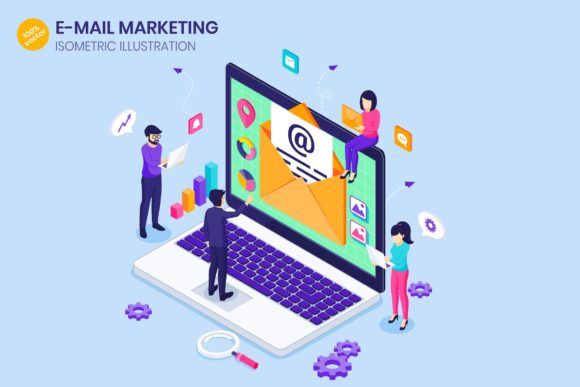
At its core, an isometric illustration uses a method of visual representation where three-dimensional objects are drawn on a two-dimensional surface without perspective distortion. Unlike traditional perspective drawing, where parallel lines converge at a vanishing point, isometric lines remain parallel. This creates a clean, grid-based look that feels both modern and structured. When applied to email marketing concepts, this style allows designers to construct elaborate scenes—such as a businessman and a team working near a giant laptop—that convey scale and activity without the visual clutter often found in photorealistic imagery.
The distinct advantage of this approach lies in its clarity. In the context of mailing services, which can often feel abstract or invisible to the end-user, isometric art makes the process tangible. By depicting servers, data streams, and human interaction in a unified, stylized environment, the illustration bridges the gap between technical backend processes and user-friendly front-end experiences. The "giant laptop" motif, frequently seen in these designs, serves as a metaphor for the central hub of digital operations, grounding the viewer in a familiar setting while elevating the stakes through exaggerated proportions.
Comparative Analysis: Isometric vs. Flat and Photorealistic Styles
To make an informed decision about incorporating Isometric E-mail Marketing Illustration into your project, it is essential to weigh it against other prevalent design categories. Each style carries its own set of tradeoffs regarding load times, emotional resonance, and brand perception.
- Flat Design: Flat design remains the industry standard for many SaaS companies due to its simplicity and fast loading speeds. It relies on minimalism, using solid colors and simple shapes. While effective for iconography and straightforward navigation, flat design can sometimes lack depth and narrative capability. An isometric approach offers a middle ground; it retains the vector scalability and clean lines of flat design but adds a layer of dimensionality that allows for more complex storytelling. If your goal is to explain a multi-step workflow, isometric often outperforms flat design by providing a spatial map for the user's eye to follow.
- Photorealistic Imagery: Stock photography featuring real people in office settings offers immediate human connection. However, it often suffers from authenticity issues and can feel generic. Furthermore, photos do not scale well across different resolutions without losing quality, and they are difficult to customize to match specific brand colors. In contrast, a vector-based isometric illustration is 100% editable. You can change the color of the team's clothing, the screen content on the giant laptop, or the background elements to align perfectly with your brand guidelines, something impossible with a static photograph.
- Full 3D Rendering: True 3D graphics offer the highest level of realism but come with significant technical overhead. They often require heavy file sizes that can slow down page load times—a critical factor for email marketing where performance impacts deliverability and open rates. Isometric illustrations mimic the look of 3D while remaining lightweight vector files (such as SVG or EPS10), ensuring crisp rendering on both mobile web and desktop environments without the performance penalty.
Technical Flexibility and Scalability
One of the most practical arguments for adopting Isometric E-mail Marketing Illustration is its technical versatility. Modern design workflows demand assets that are fluid across devices. Because these illustrations are typically created as 100% vector graphics, they possess infinite scalability. Whether the asset is used as a small icon in a mobile app, a hero image on a landing page, or a large banner for a conference booth, the quality remains pristine. There is no pixelation, regardless of how much the image is resized.
For designers and developers, the availability of source files in formats like Adobe Illustrator (.Ai), Adobe XD (.xd), Figma (.fig), and EPS10 is crucial. This editability means that the illustration is not a static dead-end but a modular component of your design system. You can isolate specific elements—such as the people team or the mailing service icons—and repurpose them for infographics or social media posts. High-resolution exports, including PNG and JPG at 300 DPI, ensure that the assets are print-ready for physical marketing materials, extending the utility of the initial design investment beyond the digital sphere.
Strategic Use Cases and Decision Factors
While the aesthetic appeal of isometric design is undeniable, it is not the appropriate choice for every scenario. Deciding to use this style should depend on the message you intend to convey and the constraints of your platform.
When Isometric is the Right Choice
This style excels when you need to visualize systems, processes, or infrastructure. If your email marketing service involves complex automation, data analytics, or team collaboration features, an isometric scene can effectively map these relationships. For example, a landing page explaining how a mailing service routes emails through various filters can use the "giant laptop" concept to show data flowing in and out, managed by a visible team. It is also highly effective for hero images on websites where you want to establish a tech-forward, innovative brand identity without the coldness of pure abstraction.
Limitations and Alternatives
However, there are situations where Isometric E-mail Marketing Illustration may introduce friction. If your brand voice is deeply personal, empathetic, or rooted in raw human emotion, the stylized nature of isometric art might feel too detached or "corporate." In such cases, custom photography or hand-drawn organic illustrations might resonate better. Additionally, while vector files are lightweight, highly detailed isometric scenes with hundreds of anchor points can sometimes render slowly on very old devices or in email clients with poor CSS support. For simple transactional emails (like password resets or receipts), a complex isometric header is likely overkill and could distract from the primary call to action.
Evaluating the Return on Design Investment
Ultimately, the decision to integrate isometric vector illustrations into your marketing stack comes down to the balance between customization, performance, and narrative depth. The ability to edit colors, resize without quality loss, and adapt the scene for web, mobile, and print provides a long-term value that static images cannot match. It allows for a cohesive visual language that grows with your brand.
When evaluating resources, look for comprehensive packages that include not just the final image, but the full suite of editable source files. The capacity to tweak the design in tools like Figma or Adobe XD ensures that the illustration remains relevant as your branding evolves. By understanding the strengths of the isometric perspective—its clarity, scalability, and modern appeal—you can determine if it is the strategic fit for your next campaign. It is a tool best used when you need to turn the abstract mechanics of email marketing into a clear, engaging, and visually compelling story.