Visualizing Unity: The Strategic Power of World Cancer Day Flat Illustration in Digital Awareness
The landscape of digital health communication has shifted dramatically over the last decade. Where once complex medical diagrams and stock photography dominated, there is now a profound appreciation for clarity, accessibility, and emotional resonance through design. At the forefront of this visual evolution is the World Cancer Day Flat Illustration, a specific style of vector art that has become instrumental in conveying messages of hope, unity, and action. This artistic approach does more than simply decorate a webpage; it serves as a vital conduit for information, bridging the gap between medical complexity and public understanding.
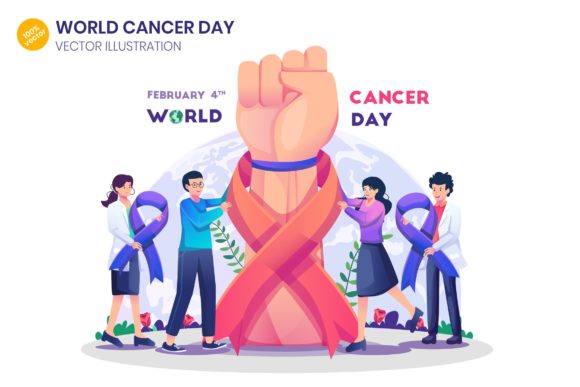
The core concept behind these illustrations often revolves around powerful symbolism. A recurring and potent motif involves people and doctors standing united against cancer, frequently depicted with a giant raised hand featuring a clenched fist. This gesture, universally recognized as a symbol of strength and resistance, is often adorned with a red ribbon on the wrist, the global emblem of cancer awareness. When rendered in a flat style, these elements lose none of their emotional weight but gain significant versatility. The removal of unnecessary textures, gradients, and three-dimensional effects allows the viewer to focus entirely on the message: solidarity in the face of adversity.
The Technical Superiority of 100% Vector Architecture
To understand why this specific style of illustration is preferred by professionals across various industries, one must look at the underlying technology. The term "100% vector" is not merely a marketing buzzword; it represents a fundamental difference in how images are constructed and displayed. Unlike raster images, which are made of a fixed grid of pixels, vector graphics are defined by mathematical paths, points, and curves. This distinction is critical when deploying assets for a World Cancer Day concept design that needs to function across a fragmented digital ecosystem.
The primary advantage of this vector-based approach is infinite scalability. In the modern web environment, an image might need to appear as a small icon on a mobile device, a expansive hero banner on a desktop landing page, or a massive print piece for a hospital corridor. A raster image, such as a standard JPG or PNG, will inevitably pixelate and lose quality when enlarged beyond its original resolution. In contrast, a vector file can be resized to any dimension without losing a single ounce of sharpness or clarity. This ensures that the details of the clenched fist and the red ribbon remain crisp and professional, regardless of the display size.
Furthermore, the editability of these files offers unparalleled flexibility for creators. Because every element within the illustration is a distinct object, designers can manipulate colors, shapes, and compositions with ease. If a healthcare organization wishes to align the illustration with their specific brand guidelines, they can adjust the palette of the doctors' coats or the background hues without compromising the integrity of the artwork. This level of customization is essential for maintaining brand consistency while leveraging high-quality pre-made assets.
File Formats and Workflow Integration
The utility of a World Cancer Day Flat Illustration extends into its compatibility with industry-standard software. A comprehensive package typically includes source files in Adobe Illustrator (.Ai), ensuring that professional designers have full access to the layer structure for deep customization. For user interface and experience designers, the inclusion of Adobe XD (.xd) files allows for seamless integration into prototyping workflows, facilitating the rapid creation of interactive health apps or informational portals.
Beyond the editable source files, the versatility continues with exchange formats. EPS10 and SVG files are crucial for web development. SVG (Scalable Vector Graphics), in particular, is native to the web, allowing these illustrations to load quickly and render perfectly on any screen density, from Retina displays to standard monitors. For situations where vector editing is not required, high-resolution exports such as PNG and JPG at 300 DPI ensure that the assets are ready for immediate use in presentations, social media posts, or printed brochures. This multi-format approach caters to a broad audience, from hobbyists creating a community flyer to researchers assembling a conference presentation.
Strategic Applications in Digital Health Campaigns
The application of these illustrations spans a wide array of digital touchpoints. One of the most effective uses is in the creation of Landing Pages dedicated to cancer awareness or fundraising. A hero image featuring the united front of doctors and patients immediately establishes an emotional connection with the visitor. It signals that the organization is proactive, supportive, and part of a larger global movement. The clean lines of flat design ensure that text overlays—such as calls to action or statistical data—remain legible and prominent.
In the realm of Mobile Web design, performance and clarity are paramount. Mobile screens offer limited real estate, and users often scan content quickly. Flat illustrations are ideal for this environment because they reduce visual clutter. The simplified shapes and bold colors guide the eye naturally to key information. Whether used in an infographic explaining early detection methods or as a banner promoting a screening event, the flat style ensures that the message is consumed rapidly and effectively on smaller devices.
Infographics represent another powerful use case. Cancer awareness often involves disseminating complex data regarding risk factors, survival rates, and prevention strategies. Integrating vector elements like the red ribbon or the symbolic fist into an infographic helps break down dense information into digestible visual segments. The ability to recolor these elements allows designers to create color-coded sections that improve readability and retention of information.
Enhancing User Engagement Through Symbolism
The psychological impact of the imagery used in health communications cannot be overstated. The specific composition of people and doctors united suggests a collaborative approach to healthcare. It dismantles the traditional hierarchy where the doctor is the sole authority and the patient is passive. Instead, it portrays a partnership. The raised clenched fist is a dynamic symbol of fighting back, instilling a sense of agency and hope in those affected by the disease. When these symbols are presented in a friendly, accessible flat style, they become less intimidating and more inviting.
This approach aligns with the principles of E-E-A-T (Experience, Expertise, Authoritativeness, and Trustworthiness). By using professional, high-quality visuals, organizations demonstrate a commitment to excellence. It shows that they value the user experience enough to invest in clear, scalable, and aesthetically pleasing design. This attention to detail fosters trust, which is the currency of the healthcare sector. Users are more likely to engage with content, donate to causes, or seek medical advice from sources that appear credible and polished.
Considerations for Implementation and Customization
While the benefits of using a World Cancer Day concept design illustration are clear, successful implementation requires thoughtful consideration. Designers must ensure that the customization of colors does not inadvertently alter the meaning of the symbols. For instance, the red ribbon is a globally recognized standard; changing its color could confuse the audience or dilute the message. Similarly, the diversity represented in the group of people should be preserved or enhanced to reflect the inclusive nature of the fight against cancer.
Accessibility is another critical factor. When embedding SVGs or using these illustrations in web graphics, proper alt text must be applied to ensure that screen readers can describe the image to visually impaired users. The description should capture the essence of the scene: "Vector illustration of diverse people and doctors united against cancer, featuring a raised fist with a red awareness ribbon." This practice ensures that the powerful message of unity reaches everyone, regardless of their abilities.
Moreover, the context in which these images are placed matters. They work best when paired with concise, empathetic, and actionable copy. The illustration draws the user in, but the surrounding text provides the necessary depth and direction. Whether the goal is to educate the public about symptoms, promote a fundraising event, or offer support resources, the visual and textual elements must work in harmony.
The Future of Health Communication Design
As we look toward the future of digital health communication, the trend toward flat, vector-based storytelling shows no signs of slowing down. The demand for content that is both emotionally resonant and technically robust continues to grow. The World Cancer Day Flat Illustration stands as a testament to this shift. It proves that design can be both beautiful and functional, serving as a tool for education, advocacy, and hope.
For business owners, educators, and creators, adopting these assets is a strategic move. It allows them to participate in global conversations with professional-grade materials that require minimal technical overhead to deploy. The ability to resize, recolor, and adapt these vectors means that a single asset can serve multiple purposes across different campaigns and years, providing long-term value.
Ultimately, the power of these illustrations lies in their ability to unify. Just as the image depicts people coming together to fight a common enemy, the use of shared, high-quality design resources brings the creative and healthcare communities closer. It standardizes the visual language of hope, ensuring that no matter where a person encounters the message—on a mobile banner, a corporate website, or an educational infographic—the symbol of resistance and support remains clear, strong, and unmistakable. By leveraging the technical advantages of 100% vector files and the emotional depth of thoughtful concept design, we can continue to amplify the voice of cancer awareness in a world that desperately needs to hear it.